Liquor inventory management is more complex than simply counting bottles at the end of the day. Bars, hotels, restaurants, clubs, and hospitality businesses need to know how much liquor was purchased, issued, transferred, consumed, sold, wasted, or lost.
The challenge becomes even greater when opened bottles are involved. A bottle may still be physically available, but only part of its contents remain. Visual estimation can easily create differences between the recorded quantity and the actual quantity.
A modern liquor inventory management system helps businesses measure stock more accurately. It creates better visibility into bottle movement, consumption, sales, transfers, and inventory variance.
The Weight Scale Inventory Management System developed by Proses India uses a mobile application and web portal to track liquor inventory. Staff can scan bottle barcodes, record bottle weights, monitor consumption, and track individual bottles throughout their complete lifecycle.
Why Liquor Inventory Management Is Important for Bars and Hospitality Businesses
Liquor is one of the inventory categories where small differences can create significant operational problems.
Consider a bar that has 100 open bottles across multiple counters. If the quantity remaining in every bottle is estimated manually, small errors can accumulate. The stock register may show one quantity while the actual physical inventory shows another.
Common liquor inventory challenges include:
- Unrecorded bottle movement
- Incorrect consumption calculations
- Excess pouring
- Breakage and wastage
- Missing bottles
- Incorrect store transfers
- Delayed stock updates
- Differences between sales and consumption
- Difficulty identifying the reason for stock loss
The Proses India case study highlights similar challenges. Manual management made it difficult to compare actual bottle consumption with invoice sales, trace bottle movement, identify inventory variance, and determine where losses occurred.
A structured liquor inventory system creates a digital record for these activities and gives managers a clearer understanding of actual stock movement.
How Liquor Inventory Management Software Improves Bottle Tracking
Liquor inventory management software can give every bottle a digital identity using its barcode.
When inventory arrives, bottle details can be recorded in the system. As the bottle moves from the main store to a bar, another location, or eventually to disposal, its status can continue to be updated.
The system described in the case study tracks bottles from purchase and store issue through weighing, transfer, sale, consumption, and disposal. Bottle statuses can also be maintained as Sold, Empty, Unchanged, or Seal Packed.
This makes bottle tracking much clearer than maintaining separate spreadsheets or handwritten stock registers.
For example, imagine that a bottle of whisky was issued from the main store to Bar A. Later, it was transferred to Bar B. A digital liquor inventory system can maintain the movement history instead of treating the bottle as missing from Bar A.
How Liquor Inventory Management Uses Bottle Weight for Accurate Consumption
Opened bottles are one of the biggest challenges in liquor stock management.
Counting a sealed bottle is simple. Measuring the remaining liquor inside an opened bottle is more difficult.
Bottle weighing provides a more systematic approach.
Staff can scan the bottle barcode and place the bottle on a connected weighing scale. The application records the current weight and uses the available bottle information to calculate consumption.
Opening and closing measurements can then be compared.
The Proses India solution uses bottle weight information to calculate actual consumption and compares it with invoice quantities. When a difference appears, the variance can be identified and recorded for further review.
This helps managers move away from assumptions and rely on measurable inventory information.
Liquor Inventory Management Helps Identify Stock Variance
Knowing how much stock is available is important. Understanding why stock is different from expected figures is even more valuable.
Suppose sales records indicate that 700 ml of a particular spirit should have been consumed. Physical measurement shows that 850 ml was actually consumed.
There is a 150 ml variance.
That difference may have occurred because of excess pouring, incorrect billing, wastage, staff consumption, breakage, or another operational issue.
Liquor inventory management software makes these differences easier to identify.
Managers can regularly compare expected consumption against actual consumption instead of discovering a large discrepancy at the end of the month.
Better Liquor Inventory Management Across Multiple Bars and Stores
Inventory becomes harder to control when a hospitality business operates several bars, storage areas, or outlets.
Stock may move from:
Main Store → Bar One → Bar Two → Empty Bottle Disposal
Without a central system, every movement creates another opportunity for incorrect records.
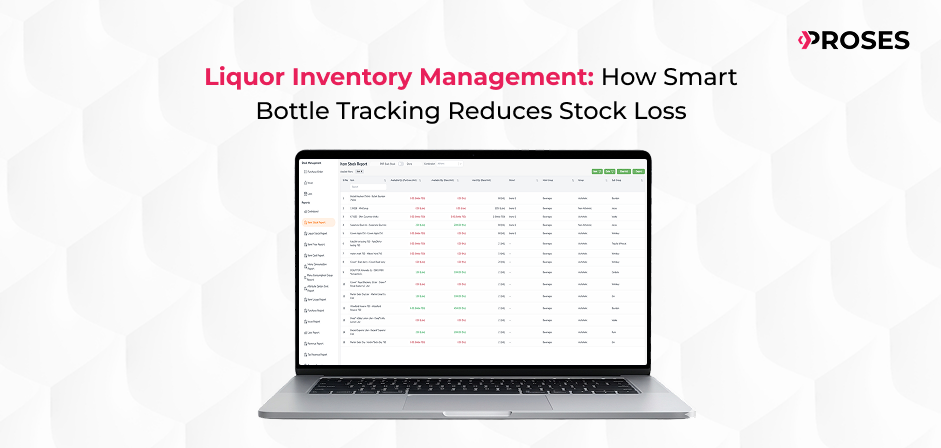
A centralized web portal can provide management with information about stock levels, transfers, bottle histories, consumption, and variance across different locations. The Proses India system includes inventory dashboards, bottle history, variance reports, inventory logs, and consumption analysis for this purpose.
This allows managers to review liquor inventory from one system rather than collecting separate records from every location.
Liquor Inventory Management Reports Support Better Decisions
Inventory reports should do more than show the number of bottles available.
Useful liquor inventory reports can help businesses understand:
- Opening and closing stock
- Bottle movement
- Actual consumption
- Expected consumption
- Inventory variance
- Bottle history
- Store transfers
- Empty and sold bottles
- Stock loss
- Consumption patterns
With accurate records, managers can identify unusual differences and investigate them sooner.
This information can also support purchasing decisions. Businesses can understand which products move quickly, which remain unused, and where stock requirements differ between locations.
Moving From Manual Liquor Inventory to Digital Control
Spreadsheets and physical registers may work when inventory volumes are very small. As bottle counts, locations, employees, and daily transactions increase, maintaining accuracy becomes much more difficult.
A liquor inventory management system brings barcode tracking, bottle measurement, inventory movement, reconciliation, and reporting into one structured process.
The goal is not simply to digitize bottle counting. The real objective is to understand what happened to every important inventory movement and identify differences before they become larger losses.
For bars, hotels, restaurants, clubs, and other hospitality businesses, better liquor inventory visibility can support more accurate stock records, faster reconciliation, stronger accountability, and informed inventory decisions.
The Proses India case study demonstrates how mobile bottle weighing, barcode tracking, centralized reporting, and variance analysis can transform traditional liquor inventory management into a measurable and traceable process.
FAQs
What is liquor inventory management software?
Liquor inventory management software helps bars and hospitality businesses track bottles, consumption, stock movement, transfers, and inventory differences. It provides a digital alternative to manual bottle counting and spreadsheets.
How do bars track liquor inventory accurately?
Bars can use barcode scanning, bottle weighing, sales records, and inventory software to track liquor stock. Comparing actual consumption with expected consumption helps identify stock differences.
How can liquor inventory software reduce stock loss?
The software provides visibility into bottle movement and consumption variance. Managers can identify unusual stock differences earlier and investigate wastage, incorrect pouring, missing stock, or recording errors.
Can liquor inventory software track opened bottles?
Yes. Systems that support bottle weighing can measure opened bottles and calculate the quantity consumed. This provides more accurate information than estimating the remaining quantity visually.
What features should liquor inventory management software have?
Useful features include barcode tracking, bottle weighing, stock transfers, consumption tracking, variance analysis, bottle history, inventory reports, mobile access, and centralized dashboards.