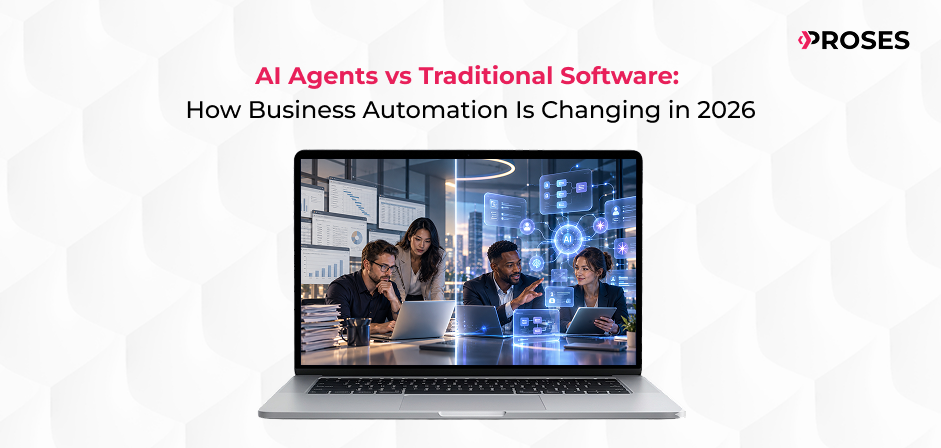
Business automation is entering a new stage.
For years, companies have used traditional software to automate predictable processes. A user enters information, the software follows predefined rules, and an expected output is produced.
AI agents introduce a different approach.
Instead of simply executing one predefined action, an AI agent can interpret a goal, analyze available information, determine appropriate steps, interact with connected systems, and complete parts of a workflow within defined limits.
This does not mean AI agents will replace traditional software.
The more important development in 2026 is how businesses can combine predictable software systems with more flexible AI-driven automation.
What Are AI Agents?
AI agents are software systems designed to work toward specific goals by analyzing context, deciding what actions are needed, and using available tools or information to perform tasks.
An AI agent may be able to:
- Understand a user request
- Retrieve relevant information
- Analyze data
- Select an appropriate action
- Interact with software tools
- Complete multiple connected steps
- Return results for human review
This makes AI agents different from conventional automation that follows only fixed instructions.
AI Agents vs Traditional Software: What Is the Difference?
Traditional software is primarily deterministic.
When predefined conditions are met, predefined actions occur.
AI agents can work with more flexible instructions and unstructured information.
Consider customer service.
Traditional software may route a ticket based on keywords or a selected category.
An AI agent could interpret the customer request, retrieve account information, review previous interactions, summarize the issue, identify possible solutions, and prepare an appropriate response.
The final action can still require employee approval.
Traditional Software Works Best With Predictable Rules
Traditional software remains extremely useful.
Payroll calculations, transaction processing, inventory updates, authentication, database management, and other structured activities often benefit from predictable software logic.
These systems provide consistency and control.
AI Agents Work With More Complex Context
AI agents become useful when tasks cannot easily be reduced to a simple set of rules.
They can process language, documents, contextual information, and multiple data sources before determining what action should happen next.
IBM has described 2026 as a period when enterprise attention is increasingly moving from experimenting with agents toward operating them safely and at scale within real business systems.
How Are AI Agents Changing Business Automation in 2026?
The key change is a shift from automating individual actions toward assisting with complete workflows.
1. From Task Automation to Workflow Automation
Traditional automation may complete one task at a time.
For example:
Receive form data → create database entry.
An AI agent could potentially handle a broader workflow:
Receive request → understand intent → retrieve information → classify request → determine next action → prepare response → update system.
This allows businesses to explore automation in processes that previously required frequent human interpretation.
2. From Fixed Interfaces to Natural Language
Users traditionally interact with business software through menus, forms, filters, and dashboards.
AI agents introduce natural language as another interface.
An employee could ask:
“Show customers with overdue invoices above a specified amount and summarize their latest communication.”
The system could interpret the request, retrieve permitted information, and present a useful response.
This may reduce the number of manual steps required to locate information.
3. From Information Retrieval to Action
Traditional search systems return information.
AI agents can potentially use information to initiate an authorized next step.
For example, a procurement agent might review inventory levels, identify products approaching reorder thresholds, prepare a purchase request, and send it to an employee for approval.
The employee remains responsible for the final decision while repetitive preparation is automated.
Where Can Businesses Use AI Agents?
AI agent applications are emerging across many operational areas.
Customer Service
Agents can classify requests, summarize conversations, retrieve relevant knowledge, and prepare responses.
Sales Operations
Agents can summarize leads, organize account information, identify follow-up requirements, and prepare communication.
Document Processing
Businesses can use AI to review reports, invoices, contracts, forms, or technical documents and extract relevant information.
Internal Knowledge Management
Employees can ask questions across approved business information instead of manually searching through multiple documents and systems.
AI Agents in Operations and Reporting
AI agents can also help collect information from connected systems, organize operational data, identify unusual patterns, and prepare reports for management review.
These applications can reduce manual information gathering without removing human responsibility for important decisions.
What Are the Limitations of AI Agents?
AI agents provide new capabilities, but autonomy also creates additional risks.
Businesses need to consider:
- Incorrect AI outputs
- Unauthorized system access
- Poor quality data
- Security vulnerabilities
- Privacy requirements
- Integration reliability
- Unexpected actions
- Cost control
- Accountability
IBM notes that AI-driven software development changes both potential productivity and cost management requirements, making measurement of business value increasingly important.
Do AI Agents Replace Traditional Software?
In most business environments, AI agents and traditional software are more useful together than as replacements for one another.
Traditional software provides structured databases, authentication, business rules, transaction systems, APIs, and predictable processes.
AI agents can provide an intelligent layer that interprets requests and coordinates selected activities across those systems.
A practical architecture may therefore look like:
User request → AI agent → approved tools and business systems → validation → human review or authorized action
This combination can provide flexibility without abandoning the reliability of conventional software.
How Should Businesses Prepare for AI Agent Automation?
Companies should avoid starting with the question, “Where can we add an AI agent?”
A better question is:
“Which business process currently requires too much repetitive human interpretation?”
Identify processes where employees repeatedly read, search, classify, summarize, compare, or transfer information.
Then evaluate:
- What outcome should be automated?
- Which systems need to be connected?
- What information can the agent access?
- Which actions can it perform?
- Which actions require approval?
- How will outputs be verified?
- How will performance be measured?
Starting with a limited workflow makes it easier to evaluate accuracy, cost, security, and actual business value before expanding the system.
The Future of AI Agents and Business Software
The future is unlikely to be a simple choice between AI agents and traditional software.
Instead, businesses are moving toward software environments where conventional applications provide reliable systems of record while AI agents create an intelligent layer across workflows.
McKinsey reports that organizations gaining greater value from AI are redesigning workflows, roles, verification mechanisms, and operating models rather than treating AI as an isolated tool.
The important question for businesses in 2026 is therefore not whether AI agents will replace software.
It is where agent-based automation can reduce unnecessary manual work while maintaining the control, accuracy, security, and accountability businesses require.
Explore AI Agent Development for Your Business
AI agent development begins with understanding the workflow, not simply choosing an AI model.
Proses can help businesses evaluate automation opportunities and develop AI-enabled software solutions designed around practical workflows, integrations, security requirements, and long-term scalability.
Planning an AI automation project? Connect with Proses to discuss where AI agents can create measurable value in your business processes.