Businesses have relied on traditional software systems for decades to manage operations, improve productivity, and reduce manual work. From ERP platforms and inventory systems to manufacturing software and customer management tools, traditional software has helped companies create structured workflows.
However, business environments are becoming more complex. Companies now generate huge amounts of data from machines, employees, customers, and connected devices. Making faster decisions requires more than predefined software rules.
This is where AI agents and AI-powered software solutions are changing the way businesses approach automation in 2026.
Unlike traditional software that follows fixed instructions, AI agents can understand goals, analyze information, make decisions, and complete tasks with limited human intervention.
For industries such as manufacturing, engineering, and precision equipment development, AI-driven automation can help improve efficiency, monitor processes, analyze machine data, and support smarter decision-making.
What Are AI Agents in Business Automation?
Understanding AI Agents and Their Role in Modern Operations
AI agents are intelligent software systems designed to perform tasks by understanding objectives, processing information, and taking actions based on available data.
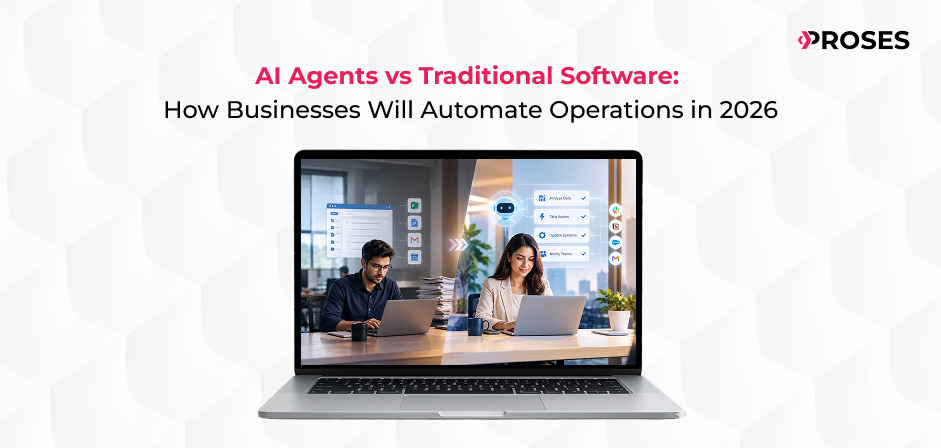
Traditional software requires users to provide specific commands. AI agents work differently. They can analyze situations, identify patterns, and recommend or execute the next steps.
For example, in a manufacturing environment, an AI agent can:
- Monitor machine performance data
- Identify unusual operating patterns
- Predict possible maintenance requirements
- Generate production reports
- Support quality inspection decisions
- Provide real time operational insights
The goal of AI agents is not only automation but also improving the quality and speed of business decisions.
Traditional Software vs AI Agents: Understanding the Difference
How Traditional Software Works
Traditional software operates using predefined rules and workflows.
A company defines a process, developers create software logic, and the system performs tasks according to those instructions.
Examples include:
- Inventory management systems
- Accounting software
- Customer relationship management platforms
- Manufacturing execution systems
These systems are reliable for structured tasks but require human involvement when situations change.
For example, a traditional machine monitoring system may display temperature readings, but an operator must analyze the information and decide whether maintenance is required.
How AI Agents Work Differently
AI agents combine artificial intelligence, machine learning, and data analysis to handle complex tasks.
Instead of only following instructions, AI agents can:
1. Understand Business Goals
AI agents can interpret user requirements and convert them into actionable tasks.
Example:
A production manager can ask:
“Identify machines that may require maintenance next week.”
The AI agent can analyze historical data, operating conditions, and performance trends to provide insights.
2. Analyze Real Time Data
Modern businesses generate data from multiple sources.
AI agents can analyze:
- Machine sensors
- Production records
- Quality reports
- Customer information
- Inventory data
This helps organizations identify opportunities and problems faster.
3. Support Automated Decision Making
AI agents can recommend actions based on data patterns.
For example:
- Adjust production schedules
- Identify quality issues
- Suggest maintenance activities
- Optimize resource utilization
Human experts remain involved in important decisions, while AI helps reduce repetitive analysis.
AI Agents vs Traditional Software: Key Differences
1. Rule Based Automation vs Intelligent Automation
Traditional software depends on fixed rules.
AI agents use data patterns and learning capabilities to handle changing situations.
For businesses operating in dynamic environments, intelligent automation provides greater flexibility.
2. Manual Input vs Goal Based Execution
Traditional systems usually require users to complete multiple steps.
AI agents can work toward a specific objective.
Example:
Traditional approach:
Employee searches multiple reports → analyzes data → prepares insights.
AI agent approach:
Employee asks a question → AI analyzes available information → provides relevant insights.
3. Static Workflows vs Adaptive Operations
Traditional software workflows remain unchanged unless developers modify them.
AI powered systems can adapt based on new information.
This is especially useful in industries where production conditions, customer requirements, and operational challenges frequently change.
How AI Agents Will Transform Manufacturing Operations in 2026
AI Agents in Smart Manufacturing
Manufacturing industries are moving toward connected and intelligent production environments.
AI agents can support manufacturers by connecting operational data with business intelligence.
Key applications include:
Predictive Maintenance
Unexpected machine downtime can impact production schedules and profitability.
AI agents can analyze:
- Machine performance data
- Operating history
- Sensor information
- Maintenance records
This helps identify possible equipment issues before failures occur.
AI Powered Quality Inspection
Quality control is critical in precision manufacturing.
AI systems can analyze inspection data, identify inconsistencies, and support faster quality decisions.
Industries dealing with high precision components, advanced machinery, and specialized manufacturing processes can benefit from AI based inspection systems.
Production Optimization
AI agents can analyze production workflows and identify improvement opportunities.
They can help businesses understand:
- Production delays
- Resource utilization
- Process bottlenecks
- Operational efficiency
This enables manufacturers to improve productivity through data driven decisions.
Why Businesses Need AI Powered Software Solutions in 2026
Increasing Data Complexity
Businesses now manage information from multiple sources.
Machines, software systems, customers, and connected devices generate continuous data.
AI agents help convert this data into meaningful business insights.
Faster Decision Making
In competitive markets, delays can affect productivity and customer satisfaction.
AI powered software helps organizations access important information faster and respond quickly.
Reducing Repetitive Work
Employees spend significant time on manual reporting, monitoring, and analysis.
AI automation allows teams to focus on strategic activities while repetitive processes are handled digitally.
AI Agents and the Future of Industrial Automation
Combining AI With IoT and Smart Machines
The future of automation will not depend only on software.
AI agents combined with IoT devices, sensors, and industrial machines will create connected ecosystems.
For example, smart manufacturing systems can:
- Collect machine data through sensors
- Analyze performance using AI
- Identify improvement areas
- Support automated actions
This combination helps businesses create more efficient and reliable operations.
How AI Agents Can Support Precision Engineering Businesses
Industries involved in advanced manufacturing require accuracy, consistency, and process control.
AI powered automation can support areas such as:
- Machine performance monitoring
- Production analysis
- Quality documentation
- Process optimization
- Equipment intelligence
For manufacturers working with advanced machinery such as CVD diamond machines, automation technologies can help improve operational visibility, maintain process consistency, and support better production management.
Traditional Software Will Not Disappear: It Will Evolve
AI agents are not replacing traditional software completely.
Enterprise software systems such as ERP, CRM, and manufacturing platforms will continue to play an important role.
The future will be a combination of:
Traditional software for structured data management
AI agents for intelligent analysis and automation
Businesses that successfully combine both technologies will create more flexible and efficient operations.
Conclusion: AI Agents Are Redefining Business Automation in 2026
The difference between traditional software and AI agents is moving from simple automation to intelligent decision support.
Traditional software follows instructions. AI agents understand objectives, analyze information, and assist businesses in taking smarter actions.
For manufacturing and industrial organizations, AI-powered automation creates opportunities to improve efficiency, reduce downtime, optimize processes, and build smarter operations.
As businesses move toward Industry 4.0, integrating AI agents with industrial systems, machines, and business applications will become an important step toward future ready operations.
Transform Your Industrial Operations With Smart Automation.
Looking to integrate intelligent automation, AI powered software, or advanced digital solutions for your manufacturing process?
Connect with Proses to explore how AI driven systems can improve operational efficiency and support smarter industrial workflows.
FAQs
What is the difference between AI agents and traditional software?
Traditional software works according to predefined rules and workflows, while AI agents can analyze information, understand objectives, and perform tasks using artificial intelligence. AI agents provide more flexible automation by adapting to changing business requirements.
How can AI agents help manufacturing companies?
AI agents can help manufacturers monitor machines, analyze production data, predict maintenance requirements, improve quality inspection, and optimize workflows. They support faster decisions by converting operational data into useful insights.
Will AI agents replace traditional software systems?
No. AI agents will work alongside traditional software systems. Enterprise platforms like ERP and manufacturing software will continue managing structured operations, while AI agents will add intelligence, automation, and advanced analysis capabilities.
How does AI automation improve industrial operations?
AI automation improves industrial operations by reducing manual tasks, identifying process issues faster, improving machine monitoring, and supporting data driven decisions. It helps businesses increase efficiency while maintaining better control over production activities.
Can AI agents be integrated with industrial machines?
Yes. AI agents can integrate with industrial machines through sensors, IoT systems, and software platforms. This allows businesses to collect machine data, analyze performance, and create smarter manufacturing environments with improved visibility and control.