AI development can create real value for businesses, but only when it is planned properly. Many companies start with excitement, choose a tool, and begin building without a clear roadmap. This often leads to delays, poor results, high costs, or solutions that do not solve the actual business problem.
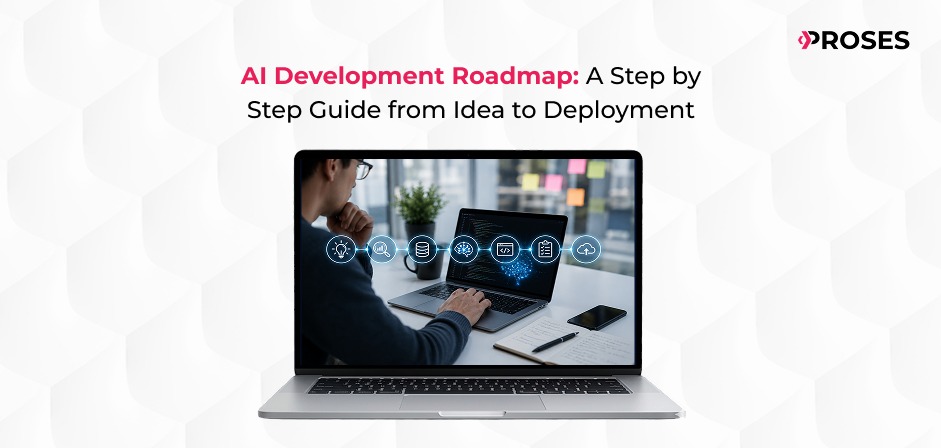
An AI development roadmap helps businesses move from idea to deployment in a structured way. It connects business goals, data, technology, people, testing, and long term improvement. Whether you want to build an AI chatbot, recommendation system, automation tool, predictive model, or intelligent mobile app, a roadmap gives your project direction.
AI Development Roadmap: Why It Matters
An AI development roadmap is a clear plan that explains how an AI idea will become a working solution. It includes the business objective, use case, data strategy, model development, testing, deployment, monitoring, and improvement.
AI is not only about technology. It must solve a real problem. For example, a business may want to reduce customer support load, improve sales forecasting, automate document processing, or personalize user experiences.
Without a roadmap, teams may work in different directions. A roadmap keeps everyone aligned and helps decision makers understand each stage.
AI Roadmap for Business Goals
The first step is to define the business goal. This goal should be specific and measurable.
For example, instead of saying, “We want AI for customer service,” a better goal is, “We want an AI chatbot that can answer common customer questions and reduce manual support requests.”
Clear goals help teams choose the right AI approach.
AI Development Objectives and Success Metrics
Every AI project needs success metrics. These metrics may include response time, accuracy, user satisfaction, cost reduction, conversion rate, or error reduction.
Success should be measured at each stage, from prototype to final deployment. This helps the team decide whether the project is ready to move forward.
Step 1: Identify the AI Use Case
The roadmap begins with use case selection. A good AI use case should solve a meaningful problem and be practical to build.
Businesses should ask simple questions. What problem are we solving? Who will use this solution? What result do we expect? What data do we have? What risk is involved?
Start with a focused use case. Trying to automate everything at once can make the project complex and expensive.
AI Use Case Examples
An ecommerce company can use AI for product recommendations. A healthcare platform can use AI for appointment reminders and patient insights. A finance company can use AI for fraud detection. A manufacturing company can use AI for predictive maintenance.
The best use case is one that gives clear value and can be tested quickly.
Step 2: Assess Data Readiness for AI Development
AI depends on data. If the data is poor, the AI output will also be poor. Data readiness is one of the most important parts of an AI development roadmap.
Businesses should check whether the data is available, accurate, complete, secure, and relevant. Data may come from mobile apps, websites, customer records, transaction systems, sensors, documents, or third party tools.
AI Data Preparation and Data Quality
Data must be cleaned and organized before it is used. Duplicate records, missing values, wrong formats, and outdated information can affect model performance.
This stage may include data collection, cleaning, labeling, structuring, and storage planning.
AI Data Security and Compliance
Data security should be planned from the beginning. Sensitive information must be protected. Access should be limited. User consent and privacy rules should be followed.
This builds trust and reduces future risk.
Step 3: Choose the Right AI Technology
Once the use case and data are clear, the team can choose the right technology. The choice depends on the problem.
Machine learning is useful for predictions. Natural language processing is useful for chatbots, search, and text analysis. Computer vision is useful for images, scanning, and detection. Generative AI is useful for content, summaries, and automated responses.
The team must also decide whether to use a ready AI service, a custom model, or a combination of both.
AI Development Technology Stack
A practical AI technology stack may include data storage, model training tools, APIs, cloud services, app backend, monitoring tools, and security systems.
The stack should support future growth. It should not only work for the first version.
Step 4: Build a Prototype or Proof of Concept
A proof of concept helps test whether the AI idea can work. It is usually smaller than the final product.
For example, a company may first build a chatbot that answers only common questions. If the results are useful, the chatbot can later be expanded.
AI Prototype Testing
During prototype testing, teams check accuracy, speed, usability, and business value. Feedback from real users is useful at this stage.
The goal is not to build a perfect product immediately. The goal is to learn quickly and reduce risk.
Step 5: Develop and Train the AI Model
After the prototype is validated, the team can start full model development. This includes selecting algorithms, training models, testing outputs, and improving performance.
Model training may require multiple rounds. The team must check whether the model is accurate, fair, reliable, and suitable for real users.
AI Model Validation
Validation helps confirm that the model works on new data, not only on training data. This is important because real users may behave differently from test data.
Poor validation can lead to wrong predictions and weak user trust.
Step 6: Integrate AI with the Application
AI must be connected with the actual product. This may be a mobile app, web application, admin panel, customer portal, or internal business tool.
Integration includes APIs, backend logic, user interface, database connection, authentication, and security.
AI Application Integration
The AI feature should feel natural inside the app. Users should not feel that the feature is forced or confusing.
For example, an AI recommendation section should be easy to find. A chatbot should give clear answers. A prediction dashboard should be simple enough for managers to understand.
Step 7: Test the AI Solution Before Deployment
Testing is a critical stage in the AI development roadmap. The solution must be tested for functionality, performance, security, usability, and accuracy.
AI testing is different from normal software testing because outputs may change based on input data.
AI Testing and Quality Assurance
Testing should cover real user scenarios. It should check how the system performs under different conditions. It should also identify bias, errors, slow response, or confusing outputs.
A strong testing process reduces launch risk.
Step 8: Deploy the AI Solution
Deployment means making the AI solution available for users. This can be done in stages. A small launch helps the team observe real usage before a full rollout.
Proses India follows a technology process that includes feasibility and analysis, designing and prototyping, core development, testing, and deployment. This type of structured process helps businesses move from idea to implementation with better control.
AI Deployment Planning
Deployment planning should include server setup, user access, monitoring, backup, documentation, and support.
The launch is not the end of AI development. It is the beginning of real world learning.
Step 9: Monitor and Improve the AI System
AI systems need regular monitoring. User behavior changes. Data changes. Business goals change. Because of this, AI models may lose accuracy over time.
Monitoring helps teams track performance, errors, feedback, and user satisfaction.
AI Model Maintenance and Optimization
AI model maintenance may include retraining, updating data, improving rules, fixing errors, and adding new features.
A successful AI solution keeps improving after launch.
Conclusion: A Clear AI Development Roadmap Reduces Risk
AI development becomes easier when there is a clear roadmap. Businesses should begin with a real problem, assess data readiness, select the right technology, build a prototype, test carefully, deploy in stages, and monitor continuously.
With Proses right planning and development support, AI can move from an idea to a useful business solution. A practical roadmap helps businesses avoid guesswork and build AI systems that are secure, scalable, and valuable.
FAQs
What is an AI development roadmap?
An AI development roadmap is a structured plan that guides an AI project from idea to deployment. It includes goals, data planning, model development, testing, deployment, and improvement.
Why is data important in AI development?
AI models learn from data. If the data is incomplete, inaccurate, or poorly organized, the AI results may be unreliable. Clean and relevant data improves performance.
What is the difference between AI prototype and AI deployment?
An AI prototype is a smaller version built to test the idea. Deployment means launching the AI solution for real users in a live environment.
Does an AI system need maintenance after launch?
Yes. AI systems need monitoring, updates, retraining, and improvements because user behavior, data patterns, and business needs change over time.